
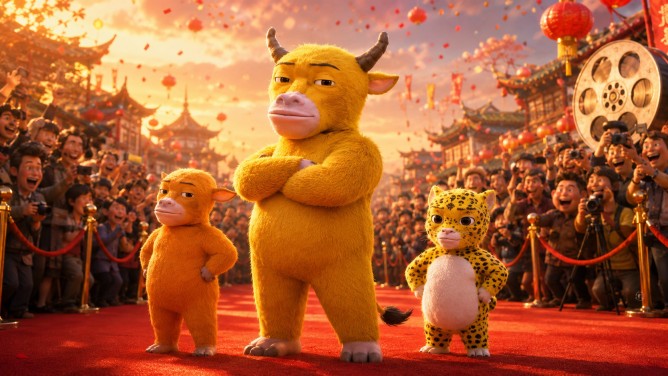
An unlikely hit at the box office, the Chinese animated film “Niu Lai,” or “The Cow is Coming,” has captured audiences with its unconventional charm. This 86-minute story about a newborn calf and a skylark unfolds in a dream-like sequence, drawing attention for its low-budget, rudimentary animation style. Initially released on August 5 to little fanfare, the film struggled to gain traction, earning a mere 7,700 yuan in its first ten days with barely 300 tickets sold across China.
The tide turned when social media users began to share and critique the film’s atypical animation and storytelling. The online buzz, filled with both amusement and curiosity, propelled the movie into the spotlight, transforming it into a viral sensation. This digital word-of-mouth phenomenon has since driven the film’s earnings to more than 14.9 million yuan, marking it as one of the year’s unexpectedly successful releases in the Chinese film industry.
“Niu Lai” stands out not only for its content but also for its creation. Crafted over five years by just two individuals, Xin Yumeng and Sun Lifang, who took on all roles from writing to voice acting, the film contrasts sharply with the polished, high-budget productions typical of the industry, such as “Ne Zha 2.” Its handmade quality has resonated with some viewers, particularly in an era increasingly dominated by artificial intelligence in filmmaking.
The film’s triumph, however, has not been without controversy. While some celebrate its grassroots appeal, others criticize the audience’s embrace of what they see as subpar production values, arguing it undermines support for more ambitious cinematic efforts. Despite these differing opinions, “Niu Lai” illustrates the power of social media and public curiosity in elevating a virtually unknown project to box office success, even without traditional marketing strategies.